Home / Schools
Schools
Why did a military engineer who could have fled to the West stay? Three lessons with slides, worksheets and tests (in Lithuanian).
Why did a military engineer who could have fled to the West stay?
Three ready-made lessons for the 125th birth anniversary of Juozas Vitkus-Kazimieraitis: for grades 5–8 and 9–12, and a lesson with the film “Kisses, Juozas”. Slides, notes for the teacher on every slide, worksheets, tests and answers. Download and teach – no preparation needed. All materials are in Lithuanian.
Download
For each lesson there are classroom slides (PowerPoint) and a teacher’s guide (PDF). The guide contains the lesson plan, what to say on each slide, expected answers, a worksheet, a test with answers and a sheet of verified facts. Guides and worksheets can be downloaded in colour or in black and white – the latter are adapted for black-and-white printers.
Why do people risk everything for freedom?
Through the life of Juozas Vitkus-Kazimieraitis, students learn what the Freedom Fights were, why thousands of people went into the forest and what it cost their families. They work through real dilemmas faced by the commander themselves, and only then find out what he decided.
- Key dates – from the 1918 Act of Independence to 11 March 1990
- Real decisions: whether to let the men register so that their families would not be deported, and what to do with a suspected spy
- An idea that survived: the 1946 and 1949 Declarations and today’s Constitution
Lithuanian curriculum: history, grade 5 (23.2.7 “Lithuanian heroes of the first half of the 20th century”, 23.1.4, 23.2.6); grades 6–8 – form period, ethics, Lithuanian language.
Classroom slides (LT)
18 slides with tasks; teacher’s notes in the speaker notes
DownloadTeacher’s guide (LT)
Lesson plan, slide by slide, worksheet, test and answers
Student worksheet (LT)
Tasks and test for students – without answers
Is it worth fighting when there is no hope of winning?
A lesson on sources and values. Students vote at the start and at the end of the lesson, and in between work as historians and as a staff: they assess figures, compare two versions of the same fight, resolve Kazimieraitis’s dilemmas and trace how the partisans’ idea found its way into the Constitution.
- Resistance in numbers, and a comparison with Latvia and Estonia
- Was the fight clean? Partisan statutes, punishments for their own, and the dark side
- 1946 → 1949 → 1992: continuity of statehood and Article 3 of the Constitution
Lithuanian curriculum: history, grade 10 (28.4.1, 28.5.2), gymnasium year III (29.1.4), year IV (30.1.8, 30.1.9); civics, grades 9–10; ethics.
Classroom slides (LT)
16 slides with tasks; teacher’s notes in the speaker notes
DownloadTeacher’s guide (LT)
Lesson plan, slide by slide, dilemma cards, worksheet, test and answers
Student worksheet (LT)
Tasks and test for students – without answers
Lesson with the film “Kisses, Juozas”
The film is watched in four parts with two pauses. Each part comes with “why” questions rather than “who and where” questions. In the discussion, students distinguish reconstruction from source, debate, and create their own code name.
- Pause points based on the film script
- A real dilemma during the screening: should the men be allowed to register so that their families would not be deported?
- Through a historian’s eyes: what the film’s narrators say and what the documents show
Trailer of the film “Kisses, Juozas”
▶Before watching: the director introduces the film (LT)“3 minutes before the cinema” · LRT. Agnė Zalanskaitė explains why “Kisses, Juozas” is worth watching. Suitable for the start of the lesson.Lithuanian curriculum: history, grade 10 (28.4.1, 28.5.2), gymnasium year IV (30.1.8), grade 5 (23.2.7). The film is rated N-7; watch it on LRT Epika.
Classroom slides (LT)
18 slides; teacher’s notes in the speaker notes
DownloadTeacher’s guide (LT)
Lesson plan, pause points, slide by slide, answers
Student worksheet (LT)
Questions for each part of the film and discussion tasks
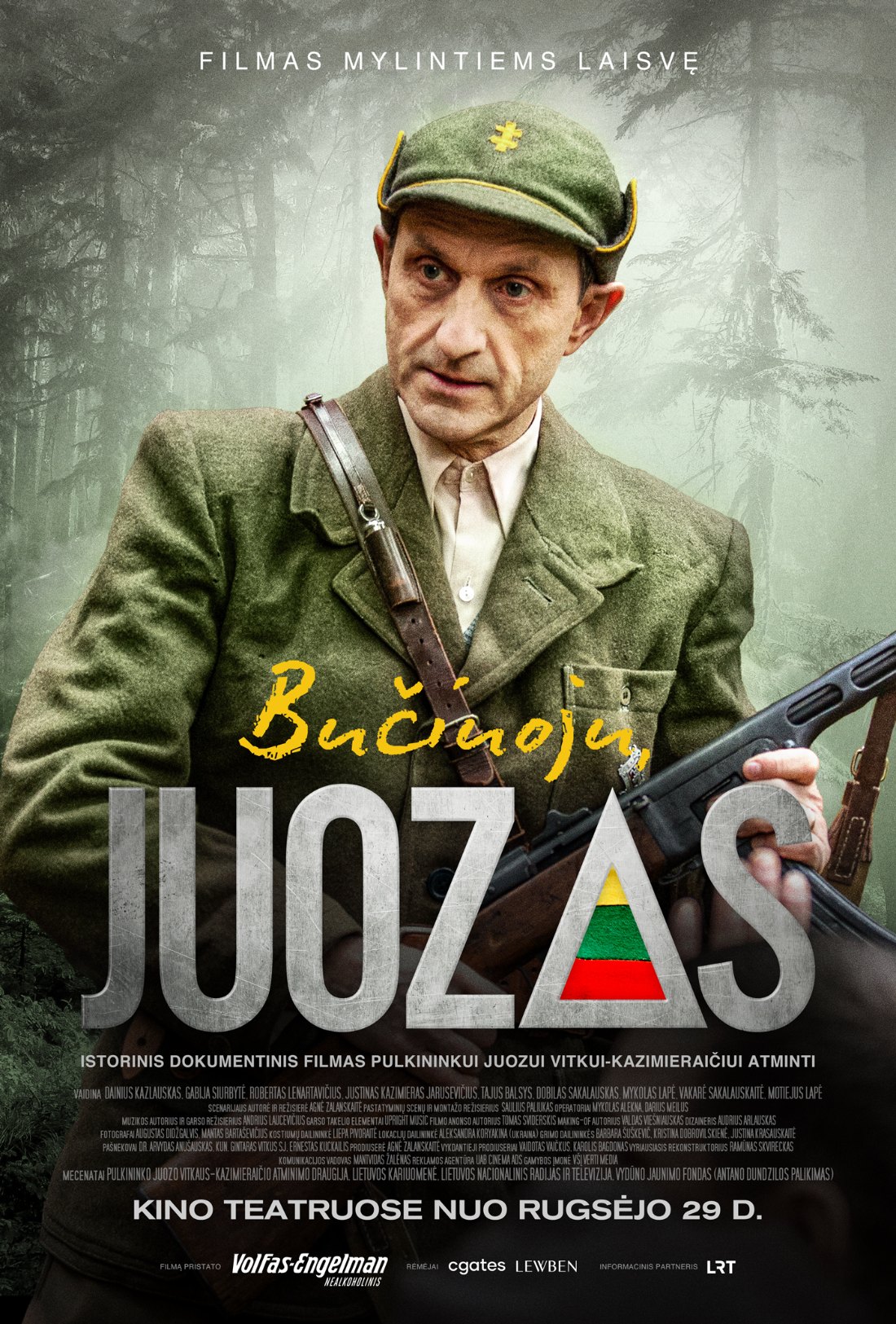
Kisses, Juozas
What could you sacrifice for Lithuania’s freedom? Would you have the courage to leave everything behind? Would you go into the forest in the face of danger, to a fight without any rules?
“Not one step from my land! That is my resolve,” the film’s main character, Juozas Vitkus-Kazimieraitis, told his brother when he had the chance to leave for a more comfortable life in the USA. The highest-ranking officer of the Lithuanian Army, a lieutenant colonel, he went into the forest in 1945 to fight with weapons for Lithuania’s freedom. There were no other officers like him. He rallied and led thousands of men in the resistance against Soviet terror in Southern Lithuania. He wrote all the documents of the partisan struggle on the basis of the Lithuanian Army’s statutes and military principles. The partisans and Adolfas Ramanauskas-Vanagas followed them for more than a decade, right up to 1956.
The film script is written in the first person. The leading role is played by the actor Dainius Kazlauskas, who conveys the drama of Juozas Vitkus’s choices and struggle with conviction and precision.
In November 2022 it was officially announced that the remains of Juozas Vitkus-Kazimieraitis, the founder of the resistance struggle, had been found in the yard of the former Soviet “stribynas” in Leipalingis. The film premiered just before the state funeral – on 21 October 2023 he was solemnly buried at Antakalnis Cemetery, near Adolfas Ramanauskas-Vanagas.
How to teach the lesson
Download
The slides and the teacher’s guide. The first page of the guide gives the lesson in brief: what students should understand and the lesson plan minute by minute.
A worksheet for each student and cards for the groups. For printing, choose the black-and-white version.
Teach
For each slide – what to say, what to ask and what answers to expect. The same text is in the PowerPoint speaker notes.
More for the class
“Kisses, Juozas” (LT)
Dramatised scenes and family testimonies. The lesson with this film is above.
Watch LRT · 2017“The Ultimate Sacrifice” (LT)
A documentary with historians’ accounts. Suitable for older students.
Watch LGGRTC · virtual exhibitionDocuments (LT)
Orders, the oath, “Laisvės varpas”, the Declaration – opens full screen.
Open the exhibition Field tripIn his footsteps
Kasčiūnai, Žaliamiškis, Leipalingis and other places in Dzūkija and across Lithuania.
PlacesQuestions for discussion
- What did his words “that is my resolve” mean? How is resolve different from choice?
- Is it worth fighting when there is almost no hope of winning?
- Why did he not want partisans who would come “out of patriotism alone”?
- Why did he order diaries to be kept “as material for history”, even though they could fall into enemy hands?
- What did 77 years without a grave mean to his family, and why is it important for the state to find its fighters?